Integrations
LumoAuth connects to your existing stack from Organization portal → Settings → Integrations (/orgs/{orgId}/portal/integrations). Every integration is configured per organization, secrets are encrypted at rest, and outbound calls are limited to public HTTPS hosts. The page is organized by category: a row of section tabs at the top (Enterprise SSO (SAML), Enterprise SSO (OIDC), Social login, Directory sync (LDAP/AD), SCIM provisioning, Observability, the categories below, and Webhooks, or Everything for one long page) switches between sections. Each provider card has a Configure (or Set up / Connect) button, and cards whose feature is not in your plan show a lock tag naming the plan or add-on that unlocks it.
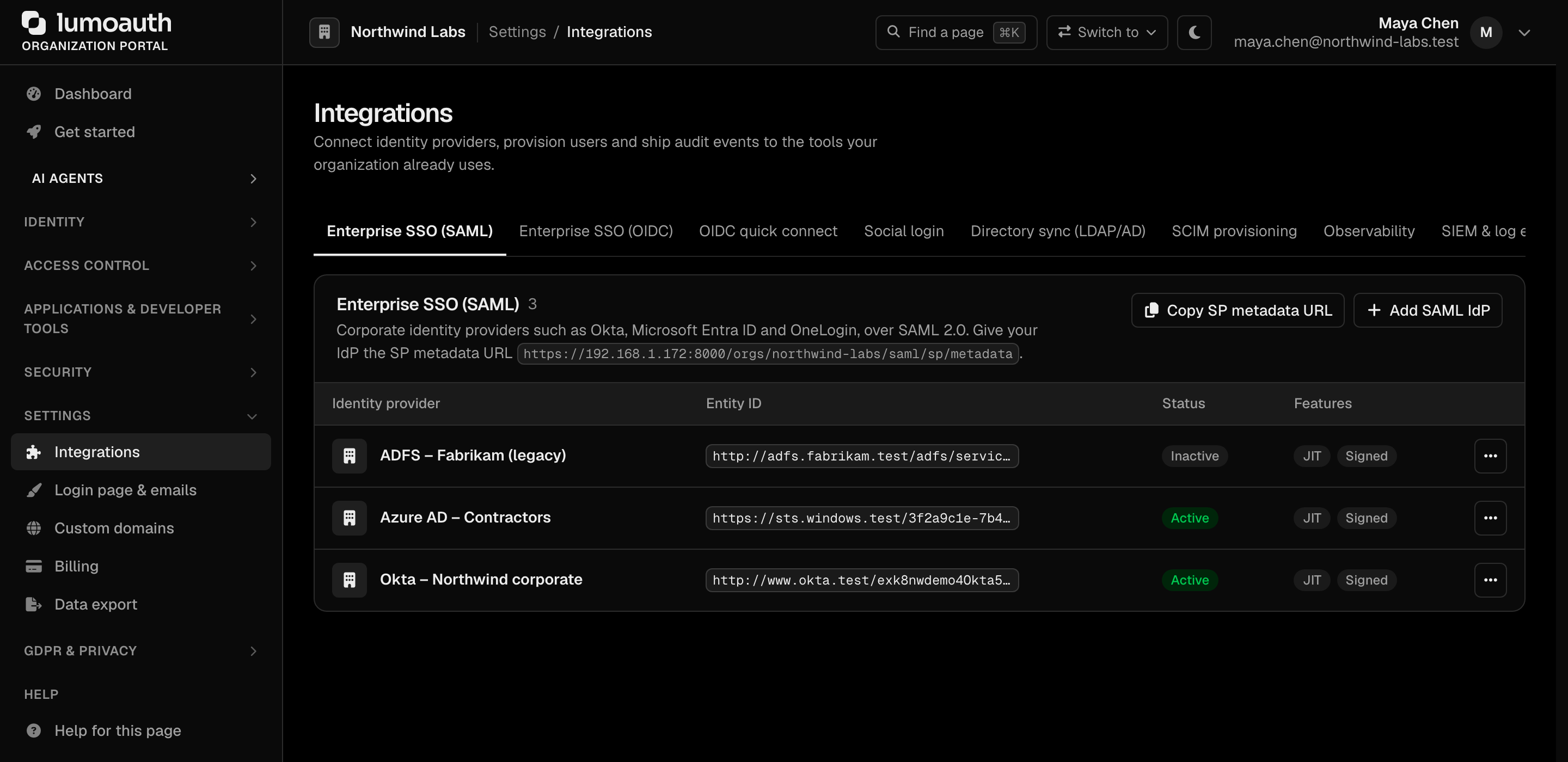
Categories:
- SIEM & log export — stream audit logs to your SIEM (security information and event management system): Splunk, AWS CloudWatch Logs, Microsoft Sentinel, Google SecOps, Elastic/OpenSearch, Sumo Logic, Amazon S3 (OCSF), OpenTelemetry, any HTTPS endpoint, Google BigQuery or Snowflake. See SIEM & log export.
- Alerting & notifications — route security alerts to Slack, Microsoft Teams, PagerDuty, Opsgenie or email. See Alert channels.
- Approval channels — approve agent just-in-time requests from Slack, Teams, ServiceNow or Jira. See Approval channels.
- Inbound signals & device posture — receive security events from other identity providers (Shared Signals Framework, SSF, and its Continuous Access Evaluation Profile, CAEP: a standard way for one system to tell another that a session or device is no longer trustworthy; Google calls its feed RISC) and device trust from endpoint security (EDR) and device management (MDM) tools. See Receiving signals and Device posture.
- Risk & bot protection — IP reputation, breached-password checks and CAPTCHA. See Risk & bot protection.
- SMS & email delivery — providers for one-time codes and transactional email. See SMS & email.
- HR & directory sync — your HR information system (HRIS) as the source of truth for joiners, movers and leavers. See HRIS sync. Outbound SCIM provisioning (SCIM is the standard for automatic user provisioning) to downstream apps lives under SCIM provisioning; see SCIM vendor presets.
- Analytics, CDP & CRM — forward authentication events to product analytics and CRM tools. See Analytics & CRM.
- Data warehouse — long-term audit analysis in BigQuery or Snowflake.
- Billing — meter usage and gate features with Stripe. See Billing.
- Key storage & HSMs — not a section of this page: the key storage provider is chosen when you generate a key under Security → Signing keys. See Key storage & HSMs.
- Secrets & developer sync — read credentials from your secrets manager, bring your own token-vault key, and push OAuth client credentials to your deploy platform. See Secrets managers.
- Agent ecosystem — agent registries, AI gateways and trace correlation.
- Passkeys & authenticators — authenticator metadata and attestation policy for passkeys (sign-in with a device biometric or security key). See FIDO MDS.